

Every book we sell is lost forever
Five fragments for the week of July 27, 2026

Hello from the end of July. I’ve been puzzling.
Here are five fragments that stuck with me last week…
Every once in a while I get fixated on something with little to no modern content. Then I’m forced to find old out of print books and dig through niche forum posts. It’s weirdly nostalgic for me since that used to be everything.
– TJ Parker on X, July 24, 2026. The hunt for rare knowledge is its own reward.
This is pairwise comparison-- a staple of user research -- and its power is that it forces a choice: there’s no “it depends,” no fence to sit on. Being made to pick one is what drags your real preferences into the open. Do that enough times, and you will start to see patterns in the “whys.” These are your preferred criteria, expressed now through the lens of day-to-day work rather than abstract values like “creativity” or “mission-driven.”
– Hilary Gridley, “jobs don’t have a fitting room,” Writerbuilder, July 15, 2026. From an article about using AI to “prototype” what it would be like to experience a given career path by translating a job listing into an excruciatingly specific day-in-the-life rundown, then comparing that to other possible days-in-the-life. This combines three of my well-worn hobbyhorses: “touching the dream” of a given path to see what it holds; pairwise comparison as a tool, just generally; and Hilary’s genius.
the problem with the labs banning biology is that interpretability sounds like biology. watching neurons differentiate, mitosis, i get flagged constantly, please don't accidentally ban interpretability research bc it rhymes with this other thing you don't like
– Nick Cammarata on X, July 25, 2026. Metaphors made dangerous.
You might say, “Aren’t all the books you sell lost forever?” Technically, every book we sell is lost forever to a customer. That’s good. That’s why we exist, to sell books.
– Charlie Becker, “Is an AI company buying up all the used books? (I don’t think so, not this time.) | #103,” May 9, 2026. This whole storyline (and the archive 100+ editions strong!) has strong novel potential. A second-generation bookseller using technology to fight the rages of technology. Paging Robin Sloan…
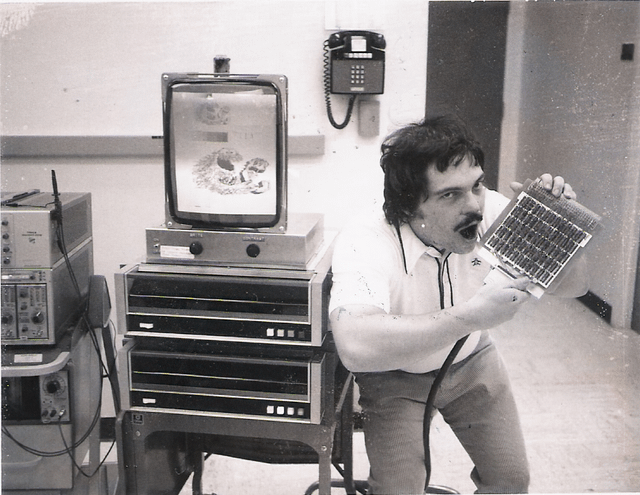
Everyone’s eyes focused on the screen as it flickered to life. Suddenly the pattern appeared. As the group watched, transfixed, Cookie Monster stared back at them, shaggy and bug-eyed, brandishing its goofy grin, flashing upon the screen while holding the letter “C” in one hand and a cookie in the other.
– Michael Hiltzik, Dealers of Lightning: Xerox PARC and the Dawn of the Computer Age, April 5, 2000. To text the Xerox Alto (one of the first personal computers!), “A few members of the lab had crafted a sort of animated test pattern by converting several drawings of Sesame Street’s Cookie Monster into sequences of digital ones and zeros.” Inside jokes and adorable mascots all the way down.
Until next time,
Diana
https://dianaberlin.com