

The inevitable gap between what we intend and what we instruct
Five fragments for the week of December 1, 2025

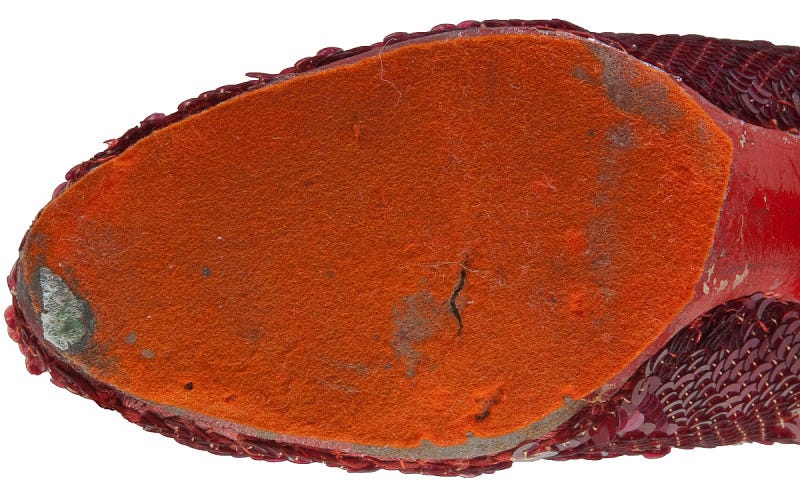
Hello from the start of December. We’re back from our family trip to Vegas, with Gamma’s team trip to Vegas for the holidays right around the corner: bookends. My daughter’s ruby slippers served her well.
This is my second year of sending these letters at the start of every week. Last year, I sent fifty, then took two weeks off at the end of the year. I think this year I’ll do the same; a tidy hundred. So after this, two more weeks to go.
Here are five fragments that stuck with me last week…
It’s surprising to me that many programmers don’t believe in AI at all, like a full, hardline “no.”
A thesis is that generative slop has such “stage presence” + being alarmingly bad that it become[s] people’s mental model of “AI.” That, along with nonchalant “vibe coders” on social media strikes a nerve with some people.
– Rasmus Andersson on X, November 30, 2025. I like the framing of “stage presence” here; slop does take up a lot of energetic space. (Also: Rasmus is the designer of Inter, “one of the world’s most used typefaces,” the opposite of slop.)
[Bert Lahr] had already been under contract to and released by Universal and 20th Century-Fox—essentially because his enormous comic energy made his screen presence almost distasteful. He was bewildered and hurt by what Hollywood was doing to him. According to his son, novelist and critic John Lahr, ‘Generally, he was slated for second-banana parts, not handsome enough for the love interest; and too grotesque in close-up (his energy made him grotesque) to work in full form in films. It’s very important to stress that he was so large a comic figure, I mean he radiated such energy and size, that the camera could only accept it as ‘real’ if he was an animal and not human.’”
– Aljean Harmetz, The Making of The Wizard of Oz, October 1, 2013. Bert Lahr played the Cowardly Lion in The Wizard of Oz. Speaking of stage presence…
“Pulp” was the “slop” of its time. A technological driver of low-cost unit economics (wood pulp paper) + lurid visual culture enabled by cheap offset color cover images, The bandwidth of print exploded. Cost per word (token) crashed. A lot more became worth writing down. The lower median quality actually signaled a remarkable expansion of written culture not a degenerative arc. Arguably it helped literacy explode and perhaps did more to drive it than the growing universal schooling movement of the same era. School might be where people learned to read, but pulp was why they eagerly learned to read. Not the allure of the “classics.”
Slop I think is similar. It’s going to drive a massive surge in cognitive capacity beneath what looks like a degenerative cultural arc. As with pulp the driver is a raw technical capability that lowers the cost of producing and distributing words at scale. But this time with extreme personalization. Words for you in particular.
– Venkatesh Rao on Substack, November 27, 2025. Slop, take 2. Supply and demand.
With the internet, we cross a threshold into an otherworld. A.I. is like a creature from the otherworld who crosses into ours. Across cultures, there are stories of nonhuman entities who fulfill our requests — or grant our wishes — according to their own logic rather than our true intentions, unable to untangle what we meant from what we said, like a large language model following a poorly written prompt. These stories warn us about more than just greed. They reveal the inevitable gap between what we intend and what we instruct, and the unforeseen consequences that follow.
– Katya Ungerman, “Your Phone Isn’t a Drug. It’s a Portal to the Otherworld.,” The New York Times, November 28, 2025. Echoes of Virginia Heffernan’s Magic and Loss: The Internet as Art.
The slippers, which are embellished with sequins and glass beads, were on display at the Judy Garland Museum in the legendary actress’s hometown of Grand Rapids, Minnesota, in 2005 when retired mobster Terry Martin used a hammer to smash the glass of the museum’s door and display case.
Martin gave into the temptation of “one last score” when he stole the iconic shoes, his lawyer wrote in court documents previously obtained by Fox News Digital. He was allegedly approached by an “old mob associate” who asked Martin if he would steal the slippers worn by Garland, who played Dorothy Gale, in the classic 1939 movie musical.
“At first, Terry declined the invitation to participate in the heist. But old habits die hard, and the thought of a ‘final score’ kept him up at night,” Dane DeKrey wrote. “After much contemplation, Terry had a criminal relapse and decided to participate in the theft.”
When Martin stole the slippers he assumed that the beads adorning the shoes were real rubies. However, Martin was later informed that they were made of glass.
“Unaware of the cultural significance and value of the slippers themselves, Terry angrily decided to simply cut his losses and move on,” according to DeKrey. “He gave the slippers to the associate who had recruited him for the job and told the man that he never wanted to see them again.[”]
– Ashley Hume, “‘Wizard of Oz’ ruby slippers worn by Judy Garland sell for record-breaking $28 million at auction,” FOXBusiness, December 8, 2024. Everyone’s talking about the Louvre heist, but why doesn’t anyone talk about this one?? Cinema in its own right.
Until next time,
Diana
https://dianaberlin.com